
The Income Tax Return (“ITR”) 7 Form is a specialized tax return form that is applicable to entities required to file returns under Sections 139(4A), 139(4B), 139(4C), 139(4D), 139(4E), and 139(4F) of the Income Tax Act, 1961. These include:
- Charitable or religious trusts
- Non-Governmental Organizations (“NGOs”)
- Political parties
- Scientific research institutions
- Universities, educational institutions, and hospitals
- Business trusts and investment funds
ITR 7 ensures financial and tax transparency for such organizations by regulating their tax exemptions and preventing misuse of tax benefits.
Who is Eligible to File ITR 7?
The ITR 7 Form applies to entities that claim tax exemptions under specific provisions of the Income Tax Act, 1961:
Section 139(4A) – Charitable & religious trusts, NGOs
- Entities earning income from property held under a trust or legal obligation for charitable or religious purposes must file ITR 7 if their total income before claiming exemptions exceeds the basic exemption limit.
- NGOs registered under the Societies Registration Act, 1860, or as Section 8 Companies under the Companies Act, 2013, must file ITR 7 if they seek exemptions under Sections 11 and 12 or 10(23C).
Also learn: Who Should File ITR 2: A Comprehensive Guide
Section 139(4B) – Political parties
A political party must file ITR 7 if its total income before claiming exemptions under Section 13A exceeds the basic exemption limit.
Also learn: How to File ITR 3: A Step By Step Guide
Section 139(4C) – Scientific research institutions & other entities
The following institutions are required to file ITR 7 if they claim tax exemptions under Section 10:
- Scientific research associations
- Educational institutions, universities, and hospitals
- News agencies
- Funds, trusts, or institutions under Section 10(23B)
Section 139(4D) – Educational institutions
Colleges, universities, and institutions eligible for exemption under Section 10(23C) but not required to file under other sections must file ITR 7.
Section 139(4E) – Business trusts
- Every business trust that is not required to furnish a return under any other provision must file ITR 7 to declare its income or loss.
- Income of business trusts is taxable at investor level, but the trust still needs to file a return for reporting purposes.
Section 139(4F) – Investment funds
- Investment funds under Section 115UB must file ITR 7 even if they are not required to file returns under any other section.
- Investment funds are pass-through entities, meaning their income is taxed directly in the hands of investors, but the fund itself must file a return for compliance.
Also learn: A Quick Guide to Pvt Limited Company
2. Who is not eligible to file ITR 7?
Entities that do not claim exemptions under Sections 139(4A), 139(4B), 139(4C), or 139(4D) are not liable to file ITR 7. Instead, they must use other applicable ITR forms.
3. Detailed explanation of ITR 7 for trusts, NGOs, and political parties
A) Charitable & religious trusts and NGOs (Section 139(4A))
Applicability:
- Charitable and religious trusts registered under the Indian Trusts Act, 1882, or other relevant laws qualify for exemptions if they use income solely for charitable or religious purposes.
- NGOs, whether registered as trusts, societies, or Section 8 companies, also fall under this category if they claim tax exemptions under Sections 11, 12, or 10(23C).
Exemptions available:
- Section 11 & 12: Income applied for charitable or religious purposes is exempt.
- Section 12: Voluntary contributions are exempt, provided they are used for the intended purpose.
- Section 11(2): NGOs/Trusts can accumulate income for future use (up to 5 years).
- Section 10(23C): Exempts income from educational institutions and hospitals.
- Section 80G: Allows donors to claim tax deductions on eligible donations.
Compliance requirements:
- Maintain proper books of accounts.
- File Form 10B (Audit Report) if gross receipts exceed ₹5 crore (as per the latest tax budget).
- Submit Form 10A or 10AB for registration under Sections 12A and 80G.
Penalties for non-compliance:
- Loss of tax exemption status.
- Taxation of entire income at standard rates.
- Penalty under Section 234F for late filing.
B) NGOs (Section 139(4A))
NGOs, registered under the Societies Registration Act, 1860, or Section 8 of the Companies Act, 2013, file ITR 7 to report their income and claim tax benefits.
Exemptions available:
- Section 10(23C) exempts income from educational institutions and hospitals.
- Section 80G allows donors to claim tax deductions on donations made to eligible NGOs.
Compliance requirements:
- Maintain proper books of accounts.
- File Form 10B (audit report) if gross receipts exceed ₹2.5 lakh.
- Submit Form 10A or 10AB for registration under Sections 12A and 80G.
Penalties for non-compliance:
- Loss of tax exemption status.
- Tax levied on entire income at regular rates.
C) Political parties (Section 139(4B))
Political parties registered under Section 29A of the Representation of the People Act, 1951, must file ITR 7 under Section 139(4B) if their income exceeds the basic exemption limit.
Exemptions available:
- Section 13A grants tax exemption on voluntary contributions.
- Exemption applies only if proper records of donations and expenditures are maintained.
Compliance requirements:
- Keep audited accounts and submit them to the Election Commission.
- Disclose donations exceeding ₹20,000.
- File returns before the due date to avoid penalties.
Penalties for non-compliance:
- Loss of Section 13A exemption.
- Taxation of the entire income at normal rates.
- Heavy penalties and scrutiny by tax authorities
4) Structure of the ITR 7 Form
The ITR 7 Form contains various parts and schedules for detailed disclosure of income, exemptions, and compliance requirements.
Part A: General information
Includes:
- Name of Entity
- PAN
- Section under which return is filed (139(4A), 139(4B), etc.)
- Registration details under Income Tax Act and other laws (FCRA, NITI Aayog, SEBI, etc.)
Part B: Filing status & audit details
If the entity is liable for audit under Section 12A/10(23C), mention the audit report date and section.
Details of unlisted shares, partnerships, and foreign assets must be provided.
Schedules to be filled (As applicable)
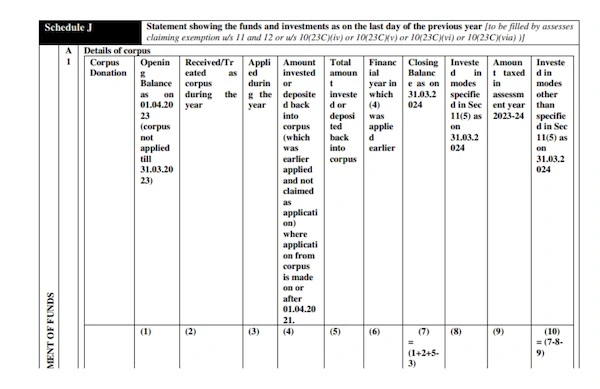
- Schedule J: Funds & investments
Discloses:
- Corpus funds
- Investments under Section 11(5)
- Loans and borrowings
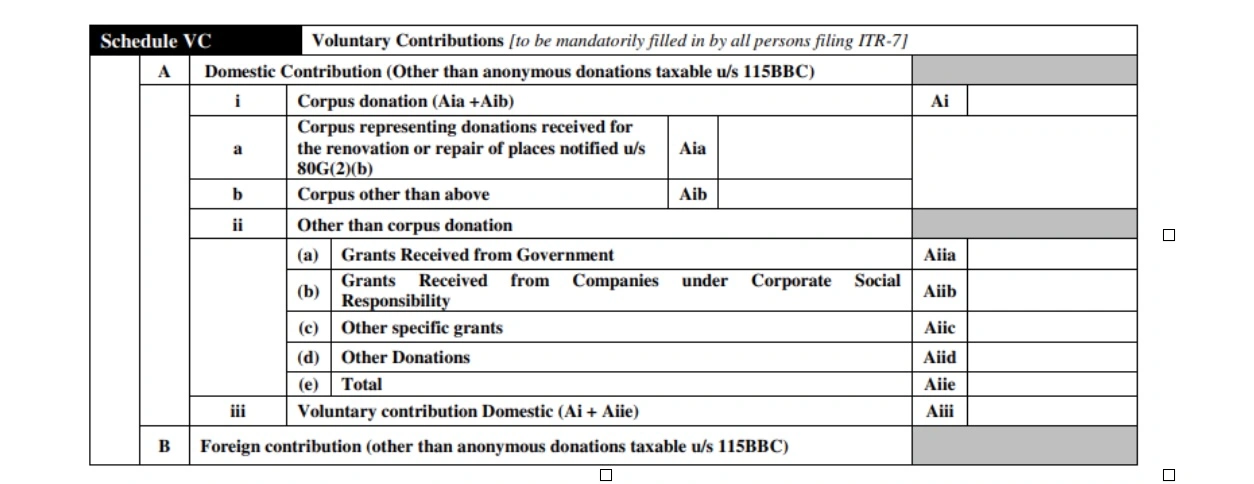
2. Schedule VC: Voluntary contributions
Mandatory for all filers, reporting:
- Domestic contributions
- Foreign contributions
- Anonymous donations taxable under Section 115BBC
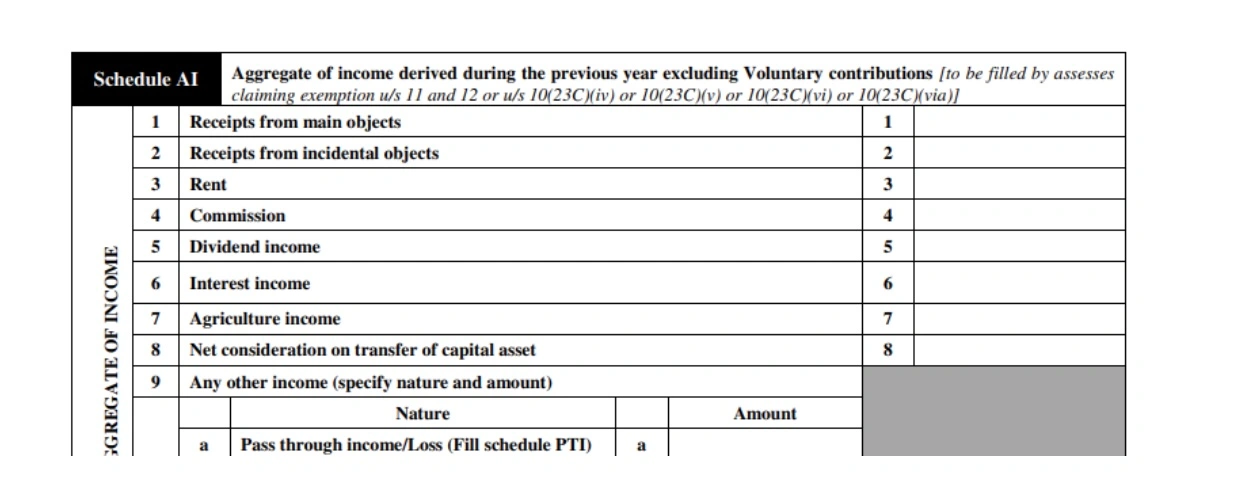
3. Schedule AI: Aggregate income
- Reports income from:
- Main charitable/religious activities
- Capital gains, interest, rent, and other sources
Also learn: ROC Compliance For Private Limited Company
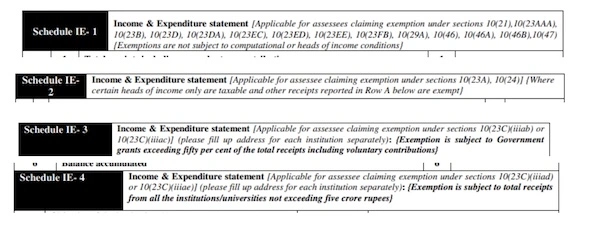
4. Schedule IE1 to IE4: Income & expenditure statement
Applicable to entities claiming exemptions under various clauses of Section 10.
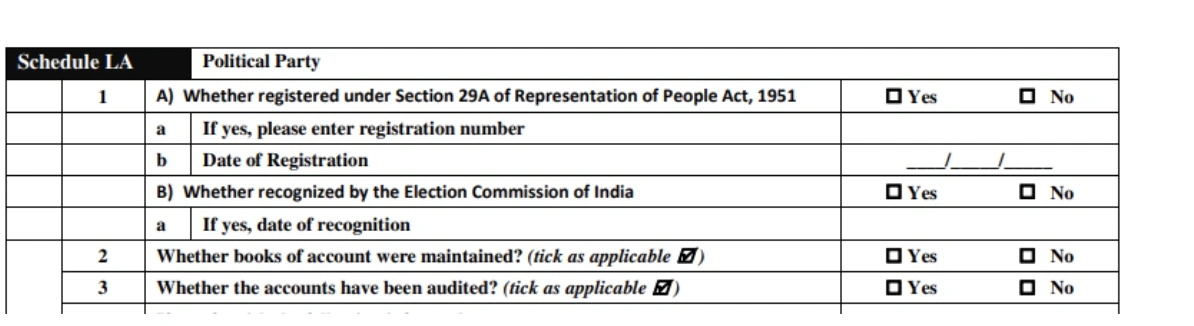
5. Schedule LA: Political party disclosures
Political parties must disclose:
- Donations above ₹20,000
- Audit status under Representation of the People Act, 1951
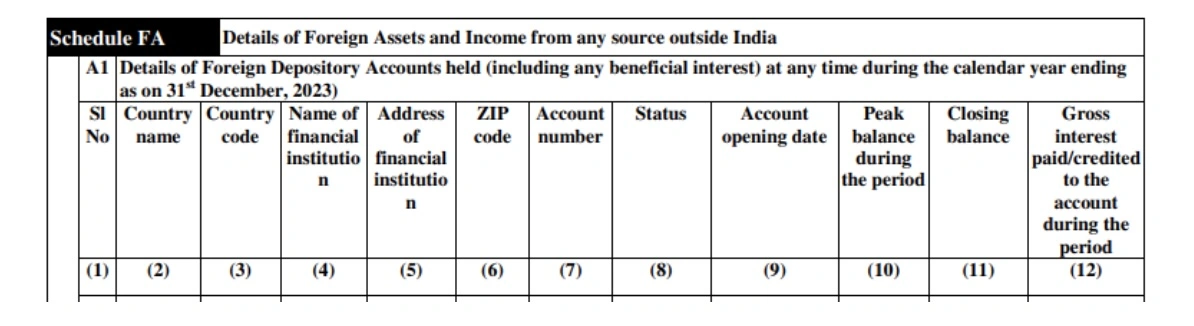
6. Schedule FA: Foreign assets & income
Mandatory for resident entities holding foreign assets or earning foreign income.
5. How to File ITR 7?
ITR 7 must be filed online via the Income Tax e-filing portal:
Step 1: Log in to https://www.incometax.gov.in/iec/foportal/.
Step 2: Select ITR 7 Form and choose the applicable section (139(4A) to 139(4F)).
Click here to access the detailed form –
https://incometaxindia.gov.in/forms/income-tax%20rules/2024/itr7_english.pdf
Step 3: Fill in Part A, Part B, and applicable schedules.
Step 4: Verify using Digital Signature Certificate (“DSC”) or Electronic Verification Code (“EVC”).
Step 5: Submit and keep an acknowledgment receipt.
6. Frequently asked questions (“FAQs”)
Click here for detailed FAQ - https://www.incometax.gov.in/iec/foportal/sites/default/files/2023-10/ITR-7%20FAQs.pdf
Q1: Who can file ITR 7?
ITR 7 is applicable to:
- Charitable and religious trusts.
- NGOs and non-profit organizations.
- Educational institutions, hospitals, and research institutions under Section 10(23C).
- Political parties claiming exemption under Section 13A.
Q2: How to file ITR 7 for trusts?
The filing process involves:
- Registration: Ensure the trust is registered under Sections 12A and 80G.
- Prepare financial documents: Income-expenditure statements, balance sheets, donation details.
- Filing Form 10B: Mandatory for trusts with income exceeding ₹2.5 lakh.
- Online submission: File through the Income Tax e-filing portal using a Digital Signature Certificate (“DSC”).
Q3: Can we file ITR 7 online?
Yes, ITR 7 must be filed online through the Income Tax Department's portal
https://www.incometax.gov.in/iec/foportal/ using:
- DSC for registered organizations.
- Electronic Verification Code (“EVC”) for authorized representatives.
Q4: How much time does it take to process ITR 7?
Processing time varies based on the completeness of documentation and verification:
- If filed correctly, it usually gets processed within 3-6 months.
- If discrepancies arise, further scrutiny may extend the processing time.
Conclusion
ITR 7 is essential for maintaining financial transparency and tax compliance for trusts, NGOs, political parties, and research institutions. Proper filing ensures continued tax benefits and legal compliance.
For official guidelines and updates, refer to the Income Tax Department's e-Filing portal.
If you want to check the latest IPOs details before making decisions you can visit our MrMoneyFrugal.com, where we publish latest updates on Indian IPOs.